
Review · JAPAN BIRDWATCHING TOURS
Nara Todaiji Lazy Bird Walking Tour
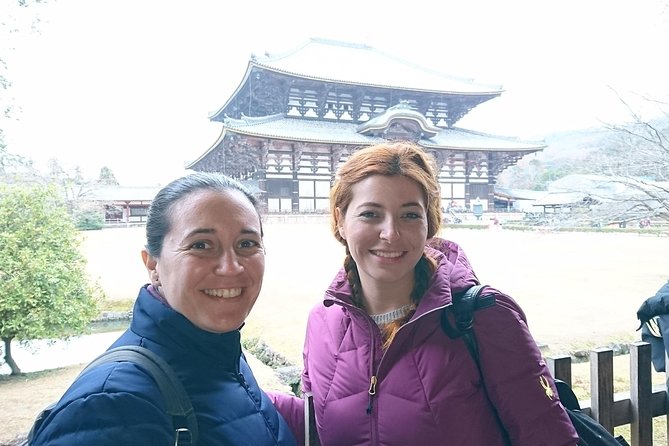
Nara’s best sights are spread through a large park, and this four-hour private walking tour links them without making you plan every turn. You’ll meet at Nara Station, walk among free-roaming deer, visit Todai-ji’s enormous Great Buddha Hall, and finish with Kasuga Grand Shrine and Kofuku-ji. I especially like the high viewpoint at Nigatsu-do and the chance to learn how Shinto and Buddhism shaped Nara.
I also like the guide-led pace. Guides such as Masa, Yuka, Noriko, Emi, and Shigeyuki have been praised for clear English, patience, and adjusting the walk for families. The main consideration is the amount of walking: comfortable shoes and moderate fitness are important, and admission fees, food, and local transport cost extra.
Key points to know before booking
- Private attention: Only your own group takes part, so the guide can adjust the pace and explanations.
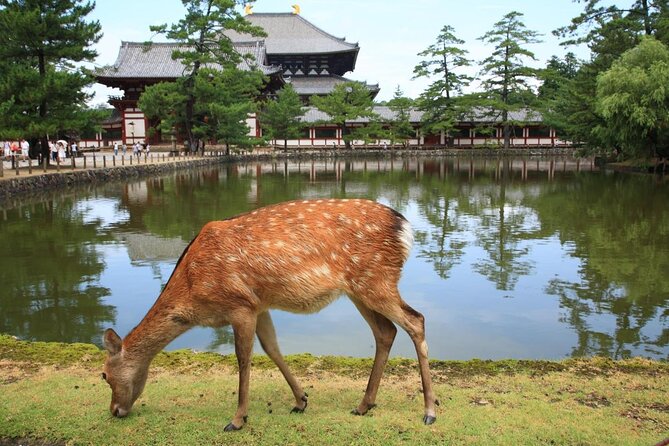
- The deer are part of the route: You can buy crackers and feed the semi-tame deer in Nara Park.
- Todai-ji is the centerpiece: The Great Buddha Hall is a huge wooden building housing one of Japan’s most famous Buddhist images.
- Nigatsu-do adds a quieter view: Its wooden terrace overlooks Nara and usually feels calmer than the main temple approach.
- A useful half-day plan: The 2 pm start works well for fitting Nara between Kyoto and Osaka.
- Extra costs matter: Plan for ¥800 in admission fees and ¥460 for public transportation, plus anything you eat or drink.
Why this Nara walk works well in four hours
Nara is easy to reach from Kyoto, with a train journey of about 30 minutes, but the sightseeing area is not a compact cluster beside the station. The temples, shrines, wooded paths, and deer-filled park cover a broad stretch of the city.
That is where this tour earns its keep. Instead of spending your limited time checking maps and working out which path leads to which gate, you follow a guide who knows the order of the stops. You see major sights, hear the basic story behind them, and keep moving.
The tour begins at 2 pm and lasts about four hours. That makes it a useful choice if you are staying in Kyoto, traveling onward to Osaka, or trying to fit Nara into a busy Japan schedule. One family even used the tour while moving between Kyoto and Osaka, which is exactly the sort of tight timetable this arrangement suits.
The private format is another advantage. You are not joining a large group with one fixed pace. If your child needs a pause, or you want more explanation at a temple, your guide can respond to your group. Feedback about guides including Yuka and Shigeyuki specifically points to patience and a willingness to adapt.
The tradeoff is simple: this is a walking tour, not a ride through Nara. You cover a lot of ground in four hours, so the experience suits you best if you can walk for most of an afternoon.
More Walking Tours in the world:
- Punta Arenas: Walk with Penguins on Magdalena & Marta Island
★ 4.6 · 611 reviews - Walk alongside Penguins on Magdalene Island and navigate Marta Island
★ 4.5 · 116 reviews - Penguin walk in Ushuaia + navigation option
★ 4.5 · 81 reviews
Meeting the deer in Nara Park
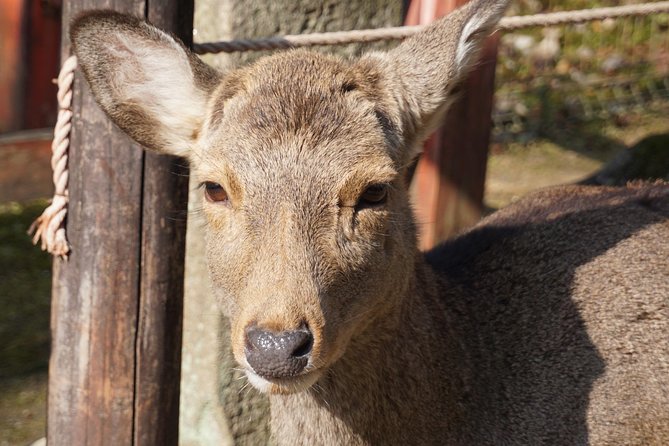
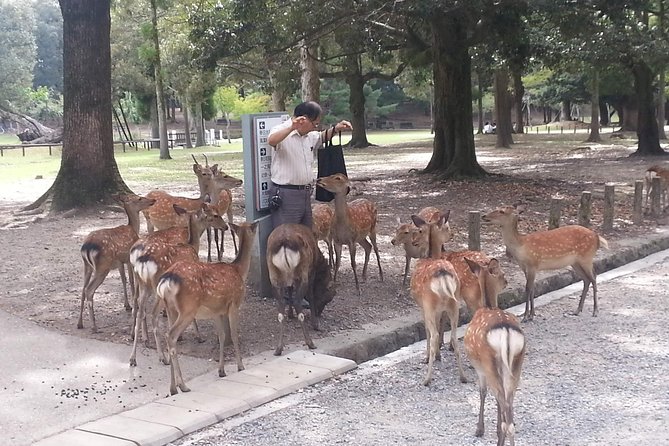
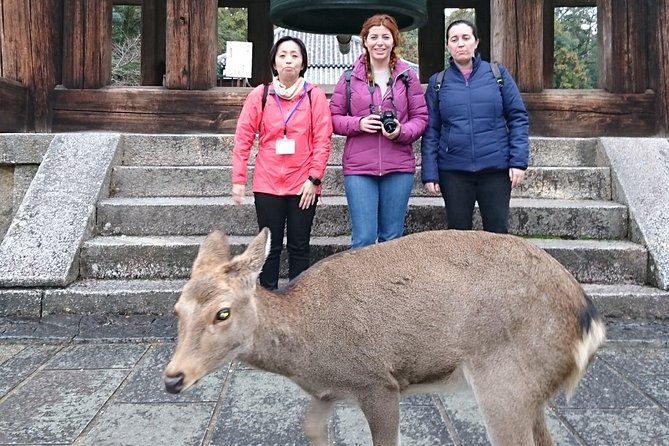
Nara Park is the natural opening to the experience. Deer roam freely here, and they are accustomed to people. You can buy special deer crackers and offer them by hand, creating the playful photos many people associate with Nara.
You get about 30 minutes for this part. That is enough time to interact with the animals without letting the deer stop the entire day. Your guide can help you make the most of the encounter and point out which deer are calmer and more comfortable around people. Masa, one of the named guides, was praised for introducing a group to particularly friendly deer.
The deer are semi-tame, not household pets. Keep your hands open after the crackers are gone, and pay attention to the animals around you. The tour allows animals, but that does not mean you should bring a pet or assume every deer wants to be touched.
This is also a good first stop because it gives you an immediate sense of Nara’s character. The park is not simply a lawn beside a temple. Deer move through the same spaces as pedestrians, and the old religious buildings appear beyond the trees and paths.
Nigatsu-do and one of Nara’s best city views
Nigatsu-do Hall is a short stop, around 20 minutes, but it may be one of the most rewarding parts of the walk. The hall has a wooden terrace, roof-hung lanterns, and a view across Nara city.
You reach it after walking through the Todai-ji grounds, and the change in mood is welcome. The main approach to Todai-ji can be busy, while Nigatsu-do feels more removed. You get a chance to look outward rather than always looking up at temple roofs and statues.
Bring a camera, but do not treat this as only a photo stop. The terrace helps you understand Nara’s layout. From above, you can see how the city sits beside wooded hills and temple grounds. The visit is brief, so your guide’s explanation helps you focus on what matters.
There are steps and uphill walking in this part of the route. If stairs are difficult for you, say so when arranging the tour. The supplied information recommends moderate physical fitness, and this stop helps explain why.
Hokke-do, an older corner of the Todai-ji grounds
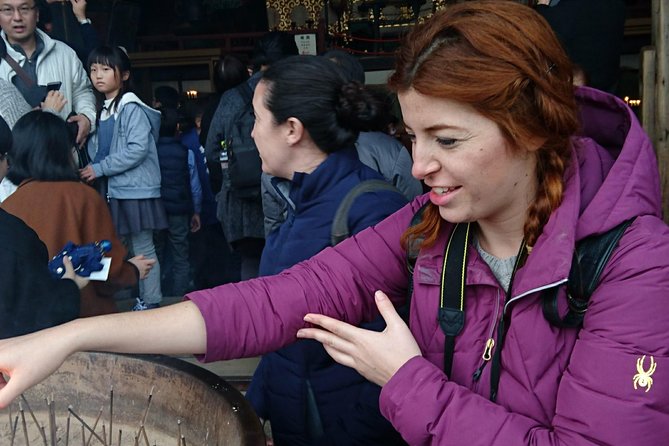
Hokke-do Hall receives about 30 minutes. It is described as the oldest building on the Todai-ji grounds and contains Buddhist statues from the eighth century.
This stop gives the tour more depth than a simple Great Buddha visit. Todai-ji is famous for scale, but Hokke-do brings attention back to individual works and the age of the site. The statues were made using distinctive techniques, and a guide can explain what you are seeing instead of leaving you to pass through without context.
Admission is not included here. The total additional admission cost for the tour is listed as ¥800 per person, so budget for that on top of the tour price. The exact allocation between sites is not specified, but you should not assume every temple entrance is free.
I like this stop for another reason: it breaks up the visual rhythm of large courtyards and grand gates. You get a smaller, older building before arriving at the most imposing structure of the day.
Same place, a different morning in the field:
- Penguin Parade, & Wildlife Encounters Eco Tour from Melbourne
★ 5.0 · 3,774 reviews - Cape Town: Cape of Good Hope & Penguins Day Tour with Pickup
★ 4.7 · 3,362 reviews - Cape Point and Boulder’s Penguins Full Day Tour
★ 5.0 · 3,118 reviews - Cape of Good Hope & Boulder Penguins Full-Day Tour from Cape Town
★ 5.0 · 2,347 reviews
Todai-ji’s Great Buddha Hall
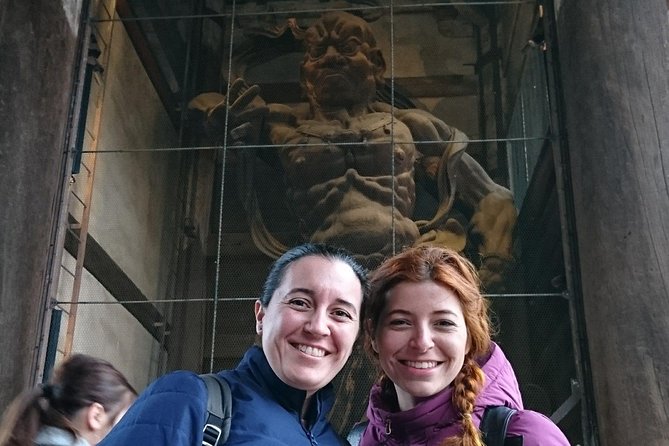
The main event is Daibutsuden, the Great Buddha Hall at Todai-ji. You approach it through the deer-filled grounds, which makes the arrival feel gradual. Then the building comes into view, and its size does much of the talking.
The hall is described as the world’s largest wooden building. Inside is the Great Buddha, a vast bronze image that gives the building its purpose and scale. You can appreciate the architecture from outside, but the interior is where the visit becomes more than a quick photograph.
You get about 45 minutes here, the longest stop on the route. That is a sensible use of time. Todai-ji is not a place to rush through in ten minutes, especially if you want to hear about its Buddhist role, the building’s construction, and the meaning of the statue.
The guide’s presence is valuable here because the building can feel overwhelming. A good explanation gives you a thread to follow: the relationship between the hall, the Buddha, and Nara’s role as an early capital. One visitor specifically described the hall and Great Buddha as especially impressive, while crediting guide Emi for being kind and well informed.
Todai-ji is also the stop most likely to feel busy. The tour does not promise an empty temple, and the route takes place in the afternoon. Still, having a guide helps you move through the essential parts without wasting time deciding where to go next.
A forest walk to Kasuga Grand Shrine
After Todai-ji, the route continues to Kasuga Grand Shrine, with about 30 minutes set aside for the shrine and its surrounding forest.
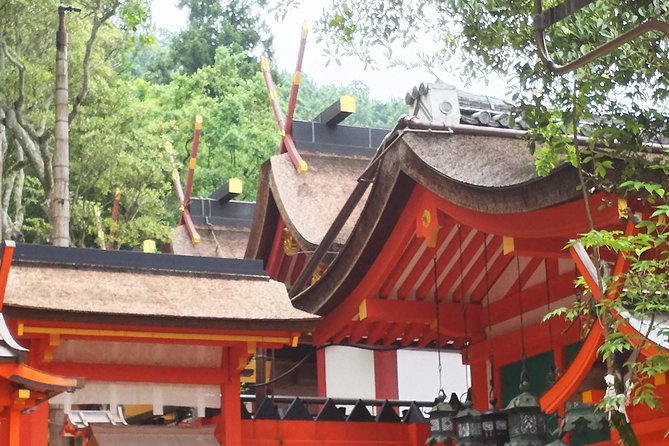
Kasuga is visually different from Todai-ji. Instead of the dark, massive presence of the Great Buddha Hall, you see bright vermilion buildings, old stone lanterns, and hanging lanterns. The forest path gives the stop a quieter feel and adds variety to the day.
This is a Shinto site, while Todai-ji and Hokke-do are Buddhist. That contrast is one of the best reasons to choose the full route rather than visiting Todai-ji alone. You can see how two major religious traditions appear side by side in Nara, and guides have helped visitors understand the difference between Shinto and Buddhism.
The walk through the trees also gives your legs a change from temple courtyards. You still need to keep moving, but the setting feels peaceful. For photographs, this may be one of the prettiest portions of the tour, especially with the lanterns and vermilion structures.
The 30-minute stop is enough for a focused visit, not an in-depth exploration of every part of the shrine. If Kasuga is your main reason for coming to Nara, you may want a separate visit with more time. If you want a balanced first look at the city, this length works well.
Kofuku-ji and the five-storied pagoda
The final listed stop is Kofuku-ji Temple, with about ten minutes allocated for it. That is short, but the visit is mainly about seeing the famous five-storied pagoda and placing it within Nara’s religious center.
The pagoda was built about 600 years ago and uses thick logs joined in a strong, layered construction. Its shape is instantly recognizable, and it makes a fine closing image for the walk.
Do not expect a long temple visit here. Ten minutes gives you time to see the pagoda and hear a concise explanation, but not to explore every building. That short stop makes sense after a full afternoon of walking, especially if your guide is keeping the tour close to its four-hour schedule.
The experience information also mentions a sake brewery in the broader day plan, though the detailed stop list gives no separate duration or admission information for it. If that interests you, ask the operator whether it is included in your particular departure.
What the price gets you
The listed price is $86.49 per person. For a private four-hour tour with a guide, that is not the cheapest way to see Nara, but the value depends on how much you want to accomplish in limited time.
You are paying for route planning, local guidance, and the ability to ask questions as you walk. You also cover a large section of Nara, from the deer park and Todai-ji to Kasuga and Kofuku-ji. If you tried to research the best order, temple opening details, and walking connections yourself, the tour could save several hours of preparation.
The extra costs are clear but should be included in your budget:
- ¥800 per person for admission fees
- ¥460 per person for public transportation
- Food and drinks are not included
- Deer crackers are an optional purchase
The transportation charge is worth noting because the tour begins and ends at Nara Station, while the sightseeing route covers a wide area. The tour is not simply a station pickup and return. Confirm how the public transport portion fits your group’s route, especially if you are arriving from Kyoto.
Group discounts are available, which can improve the per-person value if you are traveling with family or friends. Since this is a private activity, only your group participates, rather than joining strangers at a fixed group pace.
Which travelers will get the most from it
I would choose this tour if you have one afternoon in Nara and want the main sights organized for you. It is especially useful for first-time visitors, families, and anyone traveling between Kyoto and Osaka.
Families may appreciate the private format. Yuka was praised for being patient and accommodating with a ten-year-old, and the route gives children several different things to see: deer, a giant Buddha, lanterns, forest paths, and a pagoda.
The tour also suits you if you want cultural context without taking a full day. Guides have explained Shinto and Buddhism in a way that helped visitors notice more than the buildings alone. English ability has been praised for guides including Noriko, and the named guides have been described as friendly, attentive, and flexible.
I would think twice if you have limited mobility or dislike walking on uneven paths and stairs. One four-hour visit can cover a lot of ground, and the tour description calls for moderate fitness. A private guide may adjust the route, but you should discuss your needs before booking rather than assume every stop will be easy.
The 2 pm start is also worth considering. It gives you a convenient afternoon schedule, but it does not provide a full morning in Nara. If you want long visits inside every temple, this tour will feel fast. If you want a well-planned overview with time for the most important stops, it is a good fit.
Booking and cancellation details
Confirmation is provided when you book, and the activity ends back at the meeting point at Nara Station, 1 Sanjohonmachi. Public transportation is nearby, and mobile tickets make it easy to keep the booking on your phone.
The tour requires good weather. If poor weather causes cancellation, you can take a different date or receive a full refund. You can also cancel for a full refund up to 24 hours before the start time, but changes or cancellations inside that 24-hour window are not accepted.
Should you book the Nara Todaiji Lazy Bird Walking Tour?
Book it if you want to see Nara’s essential sights in one organized afternoon, especially if you are coming from Kyoto or continuing toward Osaka. The strongest parts are the private guiding, the useful mix of Buddhist temples and Shinto shrines, the deer encounter, and the viewpoint from Nigatsu-do.
The tour has received 11 five-star ratings with a 100 percent recommendation rate, and the praise centers on the guides’ communication, patience, English, and ability to cover a lot without making the experience feel rushed. That is exactly what you need from a short Nara visit.
Skip it if you want a slow, self-guided day or if long walks are difficult. But for a first visit, a family outing, or a tight Japan itinerary, this is a practical way to see much of ancient Nara without spending your precious afternoon finding the route yourself.
FAQ
How long is the Nara Todaiji Lazy Bird Walking Tour?
The tour lasts about four hours.
What time does the tour begin?
The tour starts at 2 pm.
Where does the tour begin and end?
It begins at Nara Station at 1 Sanjohonmachi, Nara, and ends back at the meeting point.
Is this a private tour?
Yes. Only your own group participates in the activity.
Does the tour include Todai-ji Temple?
Yes. The route includes Todai-ji’s Great Buddha Hall, known as Daibutsuden, as well as Hokke-do Hall on the temple grounds.
Are admission fees included?
No. Admission fees cost an additional ¥800 per person.
Can I feed the deer?
Yes. You can choose to buy deer crackers and feed the semi-tame deer in Nara Park.
Is transportation included?
Public transportation is not included. The listed transportation cost is ¥460 per person.
What should I wear?
Wear comfortable shoes and be ready for a moderate amount of walking. The tour includes temple grounds, park paths, forest areas, and some uphill walking.
What happens if the weather is poor?
The experience requires good weather. If it is canceled because of poor weather, you will be offered another date or a full refund.
Can I cancel for a full refund?
Yes. You must cancel at least 24 hours before the start time to receive a full refund. Changes or cancellations made less than 24 hours before the start time are not accepted.
Just added around the world
- Walvis Bay: Pelican Point Seal and Sandwich Harbour Tour★ 4.8 · 15 reviews
- Walvis Bay Shore Excursion: Flamingos, Dune 7, Swakopmund★ 5.0 · 3 reviews
- Victoria Falls: Private Birdwatching Safari near the town★ 5.0 · 2 reviews
- Vila Franca do Campo: Marine Life & Bird Watching & Islet Tour★ 4.4 · 9 reviews
- VIP falconry taster session★ 5.0 · 2 reviews
- Victoria Falls: Private Zambezi River Birdwatching Safari★ 4.7 · 14 reviews
- Vestmannaeyjar: Puffin, Island, and Volcano Boat Tour★ 4.4 · 7 reviews
- USHUAIA | Navigation: Sea Lions, Birds and Lighthouse★ 3.3 · 4 reviews
Japan Birdwatching Tours, compared.

Sapporo Winter : Asahiyama Zoo (Penguin Fun & Snowmobile)
Read our review →
Wild Bird Sanctuary Forest Guided Tour in Nagano
Read our review →
Penguin Fun & Snowmobile : Sapporo Winter (Asahiyama Zoo)
Read our review →
Browse the lists this tour appears in